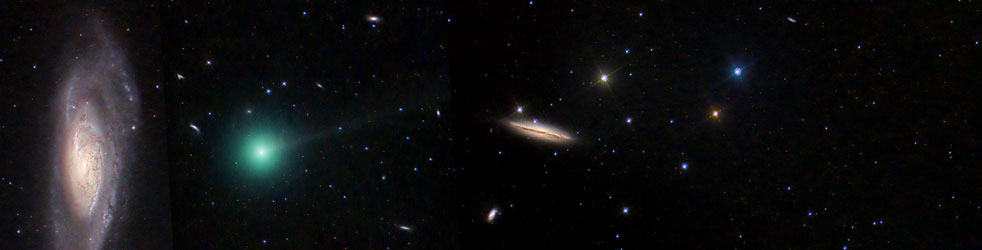
Black holes, supernovae, neutron stars, pulsars, oh gee,
… radio beasts in a gravitational sea …
Radio telescopes have been the workhorses of cosmic sky surveys for a long time. Yet, often eclipsed in public media by the Hubble and Webb space telescopes (using visible and infrared light waves). But radio wave imaging will get more respect when this new array goes operational in a few years.
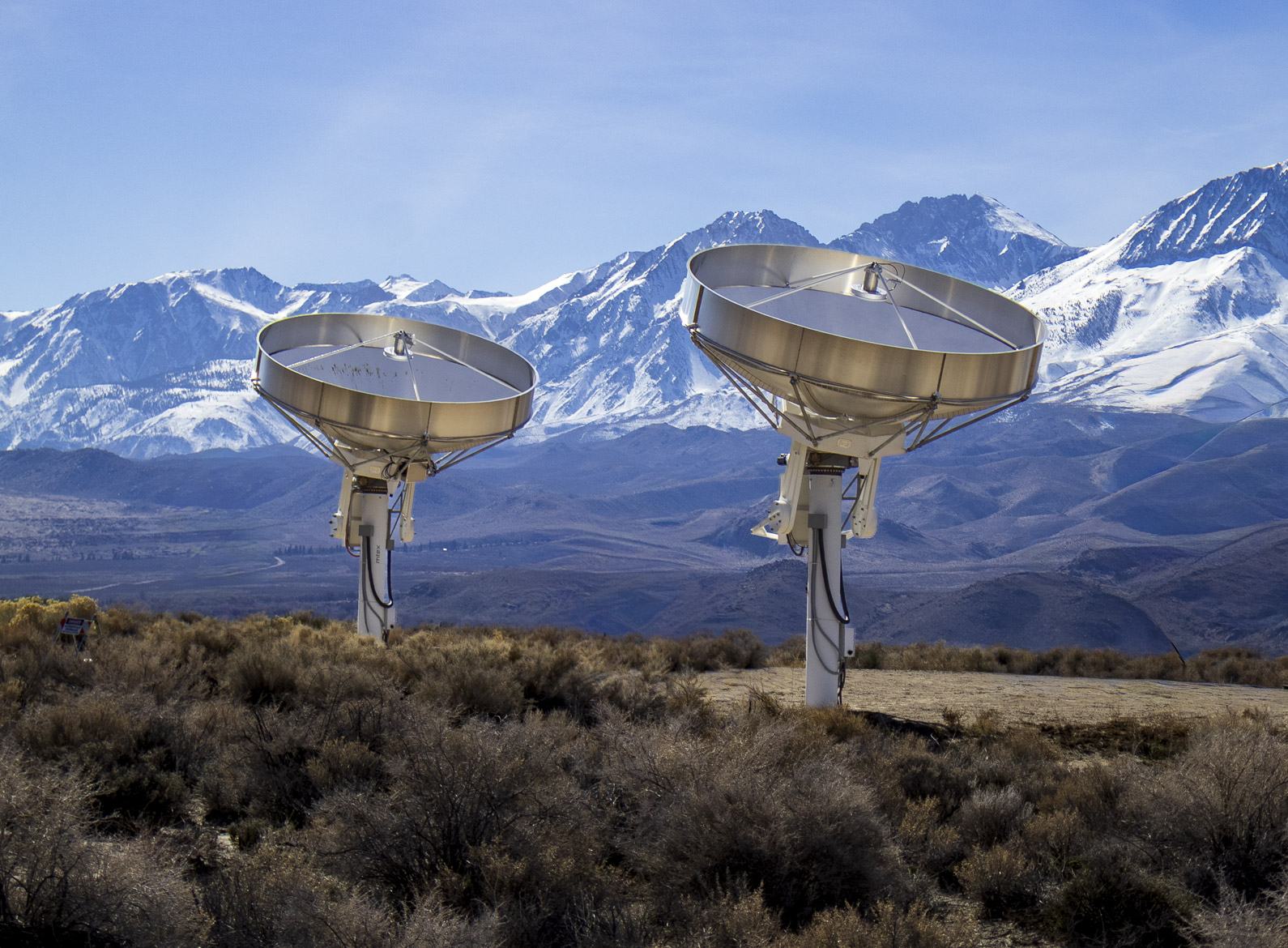
Caltech > News > Caltech Readies to Build World’s Most Sensitive Radio Telescope by Whitney Clavin (June 11, 2026) – Schmidt Sciences has greenlit the construction of the Deep Synoptic Array (DSA), a game changer for radio astronomy.
Highlights (quoted)
[The new array will be] the most sensitive radio telescope ever built, produce the highest-quality radio images, and survey the sky 100 times faster than any other radio telescope worldwide.
The DSA’s radio camera will convert the raw data to images in real time with the help of an off-site supercomputer built from cutting-edge rack-scale Graphics Processing Units (GPUs) built by Nvidia.
The radio camera images will be given freely to the public with no proprietary period.
Advances involved improving the performance of the dishes … [getting] the cost down … a new way to design the amplifiers such that cooling them will not be required … [use of] cake pans. … the perfect shape to serve as components of the feed, which converts electromagnetic waves to electrical signals.
The team … hired a baking pan company called Fat Daddio’s to manufacture thousands of cake pans for the DSA.
The many dishes of the DSA and the off-site supercomputer will be connected via a complex network of optical fiber cables …
… an eight-element test array for the DSA [will be built by the German Center for Astrophysics (DZA)] … [as a] technology demonstrator and software platform …
The DSA will serve as the radio counterpart to the optical surveys conducted by Rubin [Vera C. Rubin Observatory in Chile] and ZTF [Zwicky Transient Facility], as well as the Argus Array.
Visualization
• YouTube > caltech > Deep Synoptic Array Animation (20″) (Jun 11, 2026) – The Deep Synoptic Array (DSA) will ultimately consist of 1,650 dishes in a radio-quiet valley.
Excerpts
Our cosmos is awash with radio waves, originating from fierce jets blasting out of distant black holes, blinking dead stars closer to home, and many other exotic objects. To observe radio waves – which possess wavelengths hundreds of thousands of times longer than visible light – astronomers use two types of telescopes: huge single dishes, such as the giant FAST (Five-hundred-meter Aperture Spherical Telescope) in China, and arrays of many dishes, such as the National Radio Astronomy Observatory Very Large Array in New Mexico, whose sprawling 27 dishes were famously featured in the movie Contact.
The milestone paves the way for construction to begin. Planned for a remote valley in Nevada, the DSA will consist of 1,650 radio dishes, each slightly more than 6 meters in diameter—by far the most dishes to make up a radio array. The array will span an area of about 20 x 16 kilometers. The DSA team plans to build the telescope by 2029, with science operations commencing soon after.
The DSA is led by Caltech and funded by Schmidt Sciences. It is part of the Eric and Wendy Schmidt Observatory System, which includes three other telescope projects outside of Caltech – the Argus Array, the Large Fiber Array Spectroscopic Telescope (LFAST), and the Lazuli Space Observatory. Two pathfinder projects that led to the DSA, the DSA-110 and the OVRO Long Wavelength Array, were funded by the NSF.